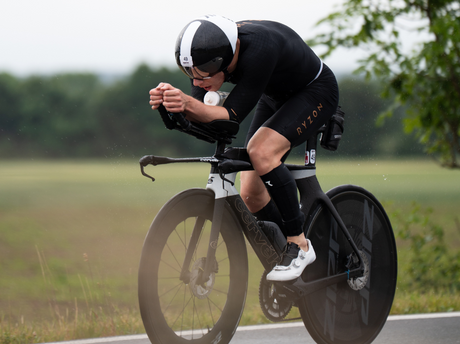
Carbohydrates in Competition: Finding the Balance Between Power and Tolerance – Guest Article by Nick Emde
For me, carbohydrates are the fuel that keeps me going in a race. Without them, nothing works—but with them, not everything is guaranteed either. To perform well in competition, it’s not just about taking in a lot of energy; it’s about absorbing it efficiently. This is where the ratio of glucose to fructose comes into play. It sounds technical, but it’s crucial when aiming to consume 90g, 100g, or even 120g of carbohydrates per hour. Science has clarified a lot in recent years. Yet, the most important question remains: What works for me personally? Because nutrition during competition and training is a highly individual matter.
Why Glucose and Fructose?
Our body can only absorb a limited amount of glucose per hour through the SGLT1 transporter in the intestines—about 60g. It used to be thought that this was the absolute limit. Then it was discovered that fructose can be absorbed via a second pathway, the GLUT5 transporter. The result: By combining glucose (for example, in the form of maltodextrin) and fructose, you can absorb significantly more carbohydrates per hour—not just consume, but actually utilize them. And that makes all the difference. There’s no point in forcing down 120g of carbs per hour if the body can only use 70g— the rest stays in the stomach, causes problems, and doesn’t provide energy.
The Ratio is Key
According to studies, the current optimum for maximum absorption is a ratio of 1:0.8—meaning one part glucose to 0.8 parts fructose. Under ideal conditions, this allows the body to metabolize up to 120g of carbohydrates per hour. For many pros, this is the gold standard—and a real game changer for long distances. Personally, I tolerate this ratio very well. In training, I use products from Maurten that are based exactly on this ratio and manage well even under intense loads. But I know this doesn’t apply to everyone.

Fructose: Boost or Belly Trouble?
Not everyone tolerates fructose equally well—and this is an aspect often overlooked in discussions. Even without a true intolerance, many athletes react sensitively, especially under stress. For such cases, there are alternatives. The brand Neversecond, for example, uses a 2:1 ratio with less fructose, making it easier to tolerate but offering a slightly lower maximum intake. I know athletes for whom this works much better than fructose-heavy options. This shows clearly: there’s no one perfect ratio... everyone has to find what works best for themselves.
Body Weight, Performance, and Individuality
Those who expend less energy also need less fuel. An age-group athlete cycling at 100 watts less than a pro over a long distance has very different requirements. For many, 60 to 80g of carbohydrates per hour is enough—and no 1:0.8 ratio is necessary. Even a classic 2:1 or 4:1 ratio (meaning significantly more glucose than fructose) works well in these cases. What matters most is what the stomach tolerates and how intense the effort is.
Nutrition Can Be Trained Too
What many forget: the body can be trained—not only with intervals but also through nutrition. I eat plenty of carbohydrates daily, including quite a bit of fructose through fruits. This has taught my body to metabolize fructose better. That’s why I handle high intake rates and the 1:0.8 ratio well in competition. On the other hand, those who rarely eat carbs in everyday life won’t be able to absorb 120g per hour easily during a race. The foundation is laid not on race day but in the months leading up to it.
Training as a Testing Ground
For me, race nutrition isn’t a last-minute mix on race day, but a finely tuned system. I regularly test different products, ratios, and amounts during intense sessions. Only under stress does it become clear what really works. I’ve learned that the stomach thrives on routine. What works in training usually works in competition. And what’s borderline in training becomes a gamble on race day.
Conclusion: No One-Size-Fits-All Formula
Research shows us the theoretical maximum, but whether it works in practice is another matter. To manage 120g per hour, you need the right ratio, good tolerance, and a solid daily foundation. The 1:0.8 ratio works very well for me, but I know many who do better with different setups. The key is to test, adapt, and not blindly follow theory. Race nutrition isn’t a numbers game. It’s personal. And in the end, what counts is the result—and the joy on the way to and across the finish line.
Image Credits:
Cover Photo: Nick Emde on his bike, photo by Dennis Glaubach.
Figure 1: Maurten, Gel 100.
Figure 2: Nick Emde running, photo by Julia Bodenschatz.

Nick Emde
Nick is a professional triathlete and studies mechanical engineering at RWTH Aachen. He has been lining up at triathlons since he was 11—racing from youth events to the Bundesliga. Today, his focus is on middle-distance races, with his first long-distance race coming soon. His goal: Hawaii! Besides sports and studies, Nick has a keen interest in sports nutrition and uses his knowledge to get the best out of himself.